

Spring Forward, Fall Behind
How the March 2026 Time Change Affects Your Sleep, Health, and Daily Life
Key Takeaways:
- On March 9, 2026, clocks spring forward one hour. This small change can cause big problems for your body and brain.
- Your body has an internal clock that follows the sun. Daylight saving time pushes that clock out of sync, making it harder to sleep, focus, and stay healthy.
- Wearable health data from hundreds of thousands of people shows that the springtime change reduces deep sleep, raises resting heart rate, and disrupts recovery.
- Sleep experts and medical groups agree: permanent standard time is the healthiest option.
On Sunday, March 9, 2026, at 2:00 AM, most of the United States will spring forward into daylight saving time. We lose an hour of sleep and an hour of morning sunlight. Across the globe, roughly 1.6 billion people in over 70 countries go through this same shift every spring.
It might not sound like a big deal. But that single hour can throw your body off in ways you might not expect. In my previous article on the hidden costs of daylight saving time, I explained why standard time is better for our health and productivity. Now, let’s look at what actually happens inside your body when the clocks jump forward, and what the latest data tells us.

Your Body Has Its Own Clock
Deep inside your brain, there is a tiny group of cells that acts like a master clock. Scientists call it the circadian clock. It tells your body when to wake up, when to feel hungry, when to release certain hormones, and when to fall asleep.
Here is the interesting part: your internal clock does not run on a perfect 24-hour cycle. For most people, it runs just a little longer than 24 hours. So every day, your body needs a reset signal to stay on track. That signal comes from the sun.
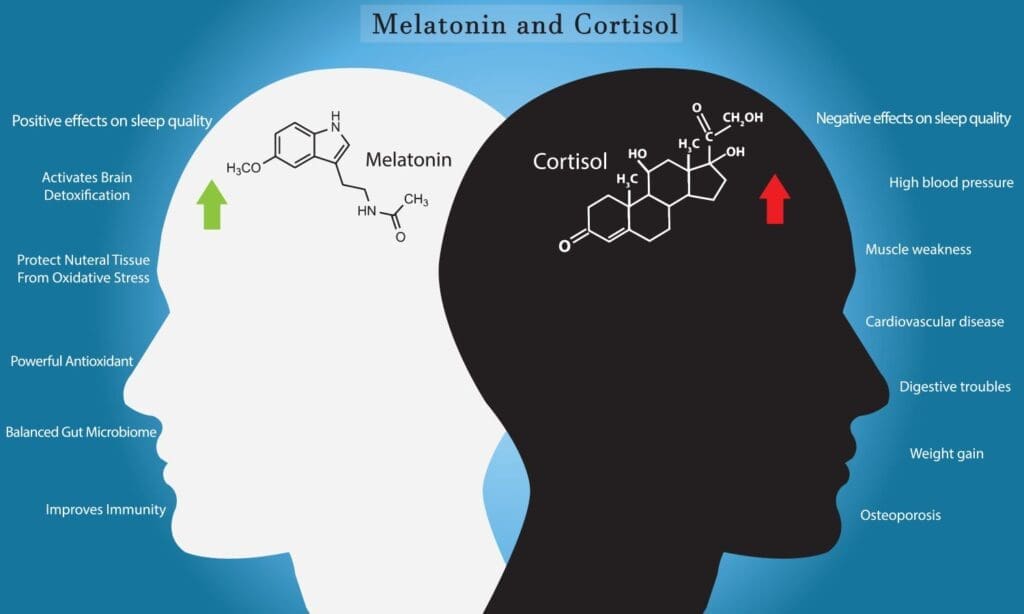
Every morning, sunlight enters your eyes and reaches special light-sensing cells. These cells tell your brain, “It’s daytime.” This morning light resets your internal clock and triggers the release of cortisol, a hormone that helps you feel awake and focused.
In the evening, when darkness arrives, your brain makes melatonin, the hormone that makes you feel sleepy. This system works beautifully as long as the sun and your daily schedule are in sync.
What Happens When We Spring Forward
When daylight saving time begins, we move the clocks ahead one hour. But the sun does not move. Your alarm goes off at 7:00 AM, but your body thinks it is 6:00 AM. Meanwhile, it stays bright later into the evening, delaying melatonin and making it harder to fall asleep.
You lose sleep on both ends. Researchers call this circadian misalignment a mismatch between your internal body clock and the external world.
Phyllis Zee, a neurologist and chief of sleep medicine at Northwestern University, explains that this misalignment happens when your internal body clocks fall out of sync with both the sun and your social schedule. Research published in Current Biology found that the circadian clock adjusts at roughly 10 minutes per day, meaning full recovery from a one-hour change can take five to seven days.
What the Data Shows Us
We no longer have to guess about how the time change affects sleep. Wearable health trackers give us real data. An analysis from Oura, a health-tracking ring company, examined 100,000 U.S. users during the March 2025 time change.
After clocks sprang forward:
- Deep sleep dropped by more than 1%. Even though total sleep time only went down about 0.3%, the loss came mostly from deep sleep, the most restorative stage your body needs to heal and recharge.
- It took longer to fall asleep. Sleep latency increased by 2% because people’s bodies were still on the old schedule.
- On the bright side, people became more active. Step counts rose by nearly 3%, workout duration rose by almost 4%, and sedentary time decreased. The extra evening sunlight likely encouraged people to get outside.
The fall time change is not much better. Data from over 644,000 Oura users showed that after gaining an hour in November, sleep became more fragmented, resting heart rate went up, and heart rate variability decreased. People also became more sedentary, spending about 10 extra minutes per day sitting.
Neither time change is good for your body. Both disrupt sleep, recovery, and daily activity patterns.
Why One Hour Matters More Than You Think
Your circadian clock controls more than sleep. It also controls heart rate, blood pressure, hormone levels, metabolism, and immune function. When your clock is thrown off, all of these systems are affected.
Research has found that the springtime change is linked to a spike in heart attacks, strokes, and car accidents in the days that follow. A 2014 study published in Open Heart found a 24% increase in heart attacks on the Monday after clocks spring forward. People are sleep-deprived and less alert, a dangerous combination.
Your immune system takes a hit, also. Research from UC Berkeley has shown that just one night of disrupted sleep can reduce natural killer cell activity by up to 70%. These are the cells your body uses to fight infections and destroy abnormal cells.
Beth Malow, a professor of neurology and director of Vanderbilt University’s sleep division, warns that staying in daylight saving time permanently would make these effects chronic. During winter, we would wake in total darkness, missing the critical morning sunlight our clocks need to stay aligned.
Over time, chronic circadian misalignment raises the risk for obesity, diabetes, heart disease, mood disorders, and even certain types of cancer. Charles Czeisler of Brigham and Women’s Hospital has noted that melatonin can slow the spread of cancer. When the circadian rhythm is disrupted, melatonin production suffers, and so does this protective effect.
Who Gets Hit the Hardest?
The time change does not affect everyone equally. Some groups are more vulnerable than others.
Teenagers and young adults are especially at risk. During puberty, the brain shifts the melatonin release to a later time. When DST pushes evening light even later, it worsens their sleep problems. Combined with early school start times, many young people end up severely sleep-deprived.
Night owls also struggle. People whose bodies prefer a later schedule are pushed even further out of sync by DST.
People with existing health conditions, especially heart disease, mood disorders, or sleep disorders, may be more sensitive to the disruption.
How to Protect Yourself This Spring
The good news is that there are steps you can take to make the transition smoother:
Start Shifting Your Schedule Early
In the days leading up to March 9, try moving your bedtime and wake-up time 15 minutes earlier each day. Over four days, you will gradually shift by a full hour, giving your body time to adjust.
Get Morning Sunlight
This is the most powerful tool you have. As soon as you wake up, get outside or sit near a bright window. Morning light tells your brain to reset its clock. Even on cloudy days, outdoor light is much brighter than indoor light and still helps.
Be Careful with Evening Light
In the evenings, start dimming your lights as bedtime approaches. Avoid screens—phones, tablets, computers—for at least 60 minutes before bed. The blue light from devices tricks your brain into thinking it is still daytime.
Watch Your Caffeine and Alcohol
Cut off caffeine at least six hours before bed. Avoid alcohol three to four hours before bed. Both interfere with sleep quality.
Try a Short Nap
If you feel tired during the day after the time change, a short nap of 20 to 25 minutes in the early afternoon can help. Keep it brief so it does not interfere with your nighttime sleep.
Why Experts Still Say Standard Time Is Best
As I discussed in my previous article, the scientific consensus is clear. Major medical organizations, including the American Medical Association and the American Academy of Sleep Medicine, support permanent standard time.
The reason is simple. Standard time keeps the sun closest to where our bodies expect it. Under standard time, noon roughly corresponds to when the sun is at its highest point. This gives us the best chance of getting morning light when we need it and evening darkness when we need to wind down.
Permanent daylight saving time would push sunrise even later in winter, leaving millions waking in pitch darkness for weeks. Without morning light, circadian clocks would drift, and health problems would become year-round.
A study in the Proceedings of the National Academy of Sciences found that moving to permanent standard time could reduce obesity and stroke rates, suggesting that simply aligning our clocks with the sun could improve public health on a large scale.
Where Things Stand on Changing the Law
Despite broad public support for ending clock changes, Congress has not reached a consensus on a solution. The Sunshine Protection Act passed the Senate in 2022 but was never taken up by the House. In October 2025, another attempt to pass permanent DST failed in the Senate.
Sleep scientists have pushed back strongly against permanent DST, arguing that permanent standard time is the only option supported by the evidence. Russia learned this the hard way after adopting year-round DST in 2011; dark winter mornings led to higher rates of depression and accidents, prompting the country to switch to permanent standard time in 2014. Several U.S. states and territories already use permanent standard time, including Arizona, Hawaii, Puerto Rico, and Guam. Mexico adopted it in late 2022. Until federal law changes, most Americans will continue changing their clocks twice a year.
Final Thoughts
This Sunday, when you set your clocks ahead, remember the effects go deeper than feeling tired on Monday. The springtime change disrupts a finely tuned biological system that controls your sleep, mood, heart rate, and overall health.
The good news is that you can take steps to protect yourself. Get morning sunlight. Shift your schedule gradually. Be mindful of evening light and caffeine. And if you feel groggy for a few days, be patient with yourself.
The science is clear that permanent standard time would be better for our health, safety, and productivity. Until that happens, the best thing we can do is understand what is going on inside our bodies and take care of ourselves through the transition.
If you are struggling with sleep, stress, or circadian disruption, I, Dr. Ginny Estupinian, offer evidence-based psychological care in Los Gatos, California. Contact my office to schedule an appointment.
Written by Ginny Estupinian, PhD, ABPP
Board-Certified Clinical Psychologist
Licensed Psychologist, California
Practice: Ginny Estupinian PhD
Location: Los Gatos, California